

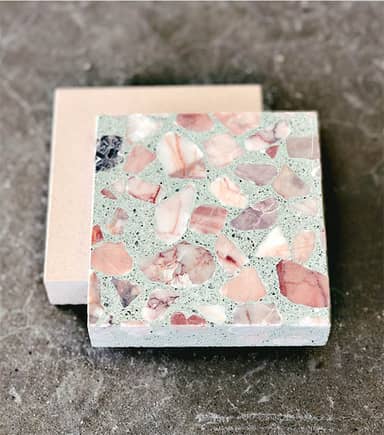


Re-Used Goods
The world's most sustainable building materials.
Building materials are a primary driver of housing cost inflation, habitat loss, and climate change. Choosing eco-friendly materials helps, but the most sustainable building materials are never mined, manufactured, or imported — they're existing unused goods available next door. Unbuilt is leading the way in putting them back to work, instead of into landfills.
01 · Waste Reduction
Living rooms, not landfills.
Every day, U.S. construction generates debris weighing as much as four Empire State Buildings. Renovations and teardowns routinely send usable material — fixtures, flooring, cabinets, tile, lumber, plenty of it brand new — to the landfill, because there is no established secondhand market to absorb it. What can't be returned or resold is simply discarded.
Unbuilt puts those goods back to work — $1.86 million back in the pockets of builders and homeowners.
Reuse differs from recycling in that it keeps a product intact and in service rather than breaking it down into a lower-grade material. A salvaged door remains a door, and a pallet of leftover tile finishes a floor, without anything having to be melted, crushed, or remanufactured.
02 · Natural Resources
Unpaving paradise.
Half of everything humanity digs out of the earth goes into buildings — more than any other sector. Most of that material is non-renewable, and the extraction itself is a leading driver of environmental loss: forests are cleared for timber, riverbeds and coastlines are altered by mining and dredging, and land is converted to quarries and the roads that serve them.
Each Unbuilt transaction saves an average of 100 lbs of natural resources from being logged, mined, or dredged.
Reuse reduces the demand for new extraction directly: a reused stone slab stands in for stone that would otherwise be quarried, and a reused cabinet for wood that would otherwise be milled. It cannot undo extraction that has already happened, but each substitution means less new material has to be taken from the ground.
03 · Affordability
American dreaming for the rest of us.
The average new American home contains $174,000 of building materials, and housing costs have outrun incomes for decades. Then supply shocks hit: lumber nearly tripled in 13 months, steel more than doubled, and everything that goes into a new home rose 41%. For homeowners, small contractors, and designers working within a fixed budget, that steady escalation puts a growing share of projects out of reach.
Buyers on Unbuilt save 54% versus new — over $5,000 back on every $10,000 of finishes.
Much of what Unbuilt lists is first-quality material that left the supply chain early — a canceled kitchen, a showroom's rotated floor models, an overproduced line, a contractor's surplus pallets. The goods are intact and often still under warranty, but because they can't return to a retail shelf, they would normally be liquidated, donated, or discarded.
Unbuilt routes that material to buyers who need it, at a fraction of retail. Sellers recover value they would otherwise have written off, and buyers pay closer to wholesale than to list price.
04 · Climate
The King of Carbon.
The built environment produces greenhouse gas in two distinct ways. Operational emissions accumulate over a building's life, from heating, cooling, and electricity. Embodied carbon comes from the materials themselves — the mining, manufacturing, and transport behind every component — and is fixed before anyone moves in. Operational efficiency does nothing to reduce it; only the choice of materials does. Because construction operates at such scale, it sits near the center of the climate problem.
A reused product's embodied carbon has already been spent, so choosing it means the new version — and the emissions of manufacturing it — never occur. Operational efficiency, solar, and offsets still matter, but none of them reduce embodied carbon: a high-efficiency building made from new materials pays that cost in full on day one.
Unbuilt is Carbon Negative.
The greenest products are those that already exist. Unlike the incremental efficiencies of recycling or clean tech, reuse prevents extraction and manufacturing altogether.
Emissions we've kept out of the air so far — and what that equals.

EPA Greenhouse Gas Equivalencies Calculator
05 · Community
From next door, not across the ocean.
The finishes and fixtures that go into a home — tile, lighting, stone, hardware — are largely manufactured overseas and shipped in, often on lead times of weeks or months. The cost of that distance doesn't appear on the materials invoice, but it surfaces as freight charges, breakage in transit, and delays that fall on the project schedule.
Unbuilt keeps supply chains local — making them faster, more resilient, and better for the communities they run through.
Buying from a seller nearby means pickup or installation can happen the same day. Every item is inspected before it's listed, so buyers are looking at the actual goods rather than a catalog rendering — which matters most when matching an existing finish. In effect, buyers and sellers source from one another locally, rather than from overseas factories.
06 · Building Better
Construction's re-use gap.
Most consumer categories have built a way to buy secondhand — resale platforms for clothing, marketplaces for furniture, trade-in programs for electronics. Construction never did. As a result, building materials, among the most resource-intensive goods produced, are typically used once and then discarded.
Bringing construction into parity with the rest of the goods economy — an estimated 20% secondhand — would yield a $200 billion market. Unbuilt is building it.
Unbuilt is a marketplace for that surplus. Manufacturers, showrooms, distributors, builders, and homeowners list goods that would otherwise be thrown out, and buyers source the sustainable building materials they need. Because each item has already been extracted, manufactured, and shipped, its environmental cost has already been paid; reuse puts that cost to work a second time.
07 · Materials
Material Categories
The table below lists construction material categories with high potential for re-use through secondhand resale. Each category has a unique impact on the environment and specific logistical drivers that generate large amounts of excess, unused goods.
| Environmental | Logistics | ||||
|---|---|---|---|---|---|
| Category | Resources | Mass | Overages | Returns | Discontinuation |
| Tile | Cement, fired clay | ||||
| Stone | Quarried stone, silica | † | |||
| Flooring | Timber | ||||
| Windows | Aluminum, vinyl, glass | ||||
| Kitchen & Bath | Metals, finishes, ceramics | ||||
| Lighting | Metals, electronics | ||||
| Appliances | Metals, refrigerants, electronics | ||||
† Stone overages are sold as remnants — offcuts and unused slab left after fabrication.
Environmental Drivers
These factors determine how much environmental impact is locked into a product.
- Mass — Large or heavy goods consume more resources and require more energy to extract, manufacture, and transport, making them the core contributor to a product's embodied environmental impact.
- Resources — Construction goods consume and create resources that are often scarce or hazardous: quarried stone and the silica dust that causes silicosis, the sand and aggregate that concrete depends on, now increasingly scarce worldwide, and timber products that drive deforestation — along with the metals, refrigerants, and electronics that make landfills toxic.
Logistics Drivers
These factors drive the excess material production, consumption, and waste that resale recovers.
- Overages — Because of long supply-chain timelines and the astronomical cost of construction delays, builders are forced to over-order materials, typically by 10–20%, so that design changes can be accommodated without running out of supplies. As a result, most projects end with leftover extras that are hard to return and difficult to store.
- Returns — Items with nuanced designs, finishes, and specifications, especially those that deal with electricity, heat, or water, are increasingly bought through eCommerce sites and shipped to job sites sight unseen. This leads to high return rates — and uninstalled, re-boxed fixtures that online dealers struggle to resell as new.
- Discontinuation — Construction goods are designed to meet rapidly changing aesthetic tastes, regional building codes, and product-safety and technical standards. Manufacturers must constantly release new product lines and discontinue older ones, often leaving large quantities of perfectly good inventory behind.
Methodology
How we count.
Impact claims are easy to make and hard to back up. We document every assumption, flag what's measured versus modeled, and publish the formula behind every number.
The formula
Weight × carbon intensity (kg CO₂e/kg) × substitution rate (0.90). Three inputs, all sourced, all visible — applied to every transaction.
The sources
Primary: ICE Database v4 (Circular Ecology / University of Bath). Secondary: EC3, the open EPD database. Both cited per-row in our CII reference.
The boundary
A1–A4 — cradle to job site. Includes factory-to-site transport (default a4 = 0.15) so we don't undercount distance.
The honesty tier
Every per-product number is labeled measured, estimated, or default. Historical estimates use conservative category-tier weights; live transactions use measured PKG weight when available.
The numbers above represent 3,092 items sold through October 2026, scored against the same engine that runs on every live listing today. Methodology v1.0 · last refresh: October 10, 2026. See the full fact sheet →
Live Impact Data
Every product makes a difference.
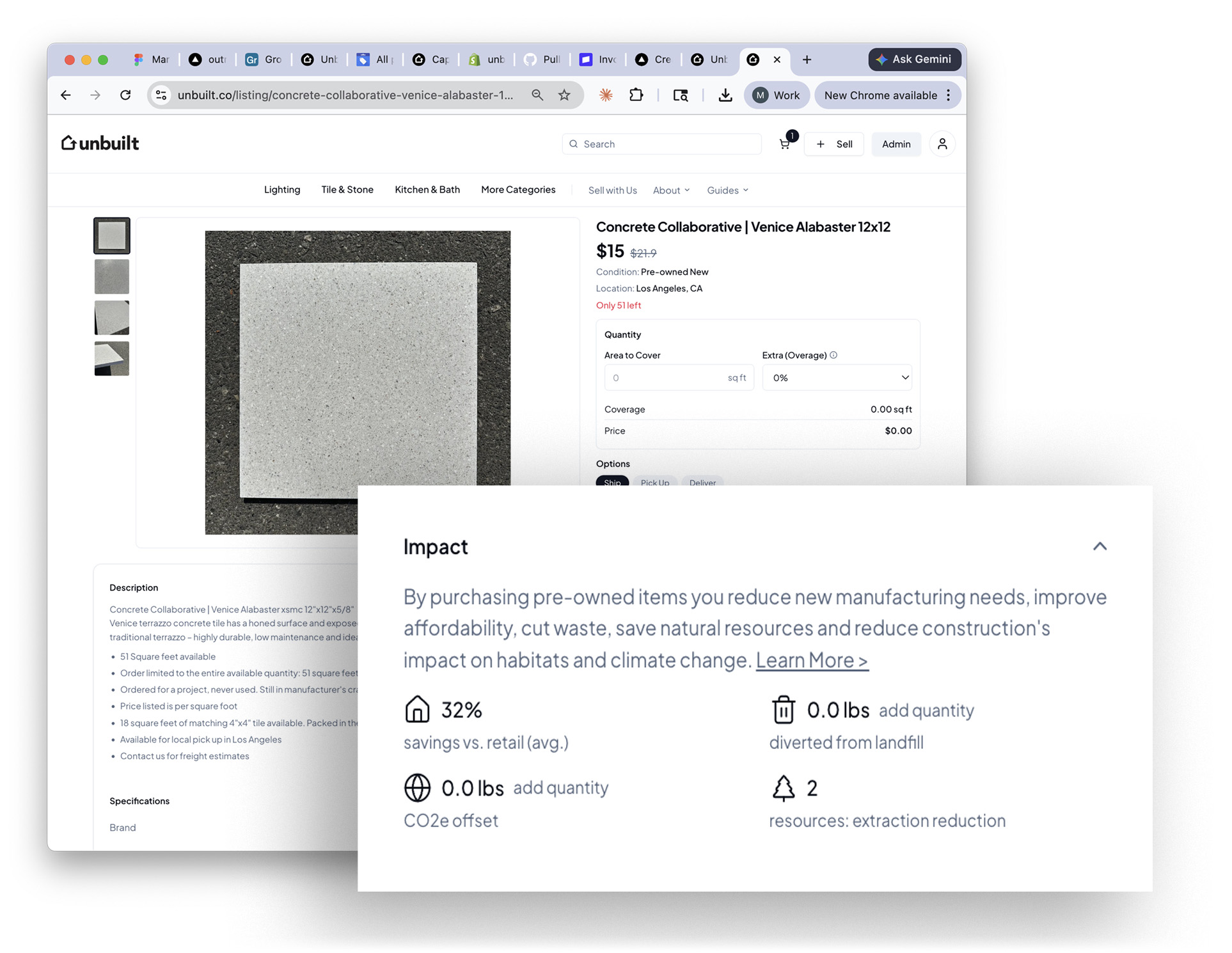
Every listing on Unbuilt carries its own impact figure: the resources, dollars, and carbon it represents, calculated for that specific product rather than taken from a category average. The same accounting that produced the numbers on this page runs on each item in the catalog, so the effect of a renovation, an office build-out, or a single fixture can be measured as it adds up.
Used Materials
Unconditional love.
At Unbuilt, we love goods in any condition, but we typically focus on those that are new and unused. This includes job site leftovers, unopened or uninstalled customer returns, or discontinued lines from manufacturing partners. For some categories of goods that may be high-value, or where previous use does not degrade quality significantly, we make exceptions, including some types of materials, windows, reclaimed wood, flooring, and appliances. For older goods that fall outside these categories, we recommend:
- Build Reuse — to find local salvage yards in your area.
- Habitat for Humanity ReStores — a national network of local non-profits.
- Facebook Marketplace — a good place to self-list items for attention from a large, diverse community of interest.
Work with us
Unbuilt is construction's circular marketplace.
Partners
Manufacturers, dealers, designers, architects, developers, deconstruction businesses, and non-profits — anyone routing excess to its next life.
Start a conversation →Press
Fact sheet, methodology notes, case studies, and founder availability for interviews.
Read the fact sheet →